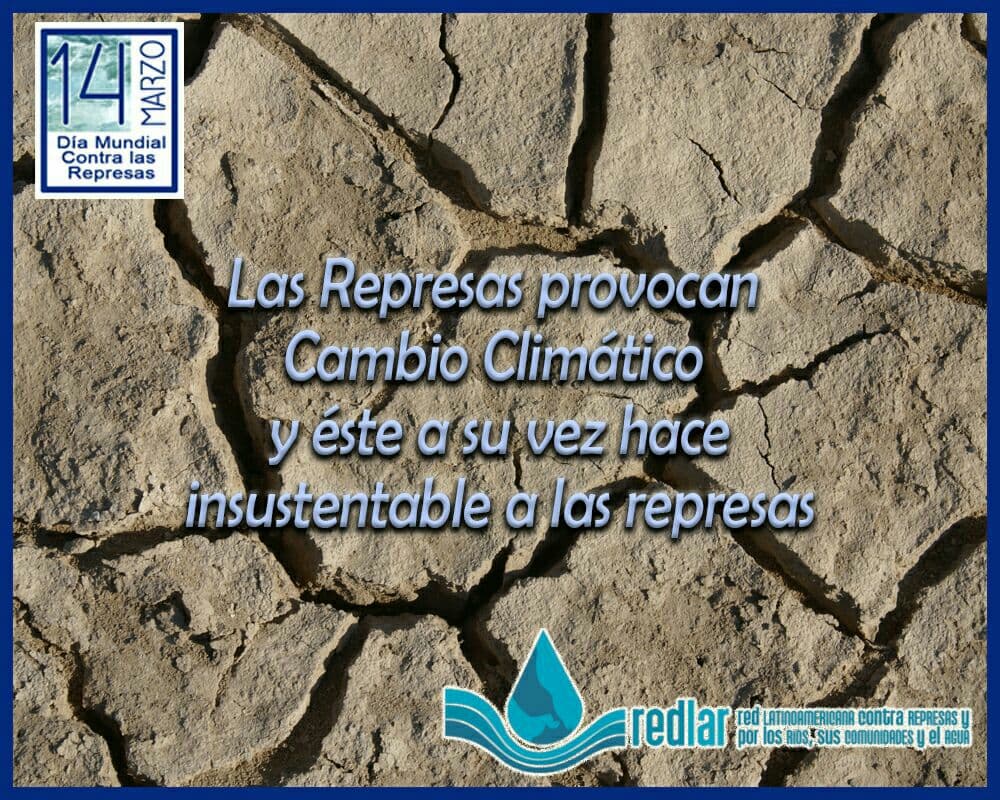
14 de marzo Día Mundial Contra las Represas
Publicado 04/06/2020 – Atualizado 15/03/2021
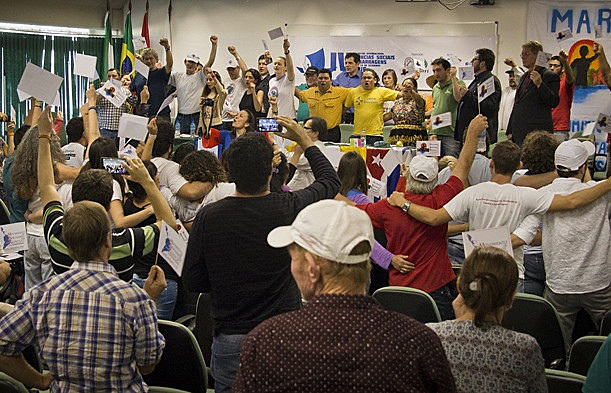
Durante o 4º Encontro Internacional de Ciências Sociais e Barragens, realizado na Universidade Federal da Fronteira Sul, em Chapecó (SC), entre os dias 19 e 23 de setembro, foi fundado o Movimiento de Afectados por Represas na América Latina (MAR), constituído por organizações de 12 países, México, Colômbia, Brasil, Chile, Honduras, Guatemala, Bolívia, El Salvador, Argentina, Peru, Brasil e Cuba. Desde 2010, essa organização de movimentos populares que fazem a luta contra as barragens estava sendo gestada. Nesses anos, foram se intensificando as articulações internacionais na América Latina a partir da análise de que os problemas dos atingidos e a forma de atuação das empresas e dos estados nacionais eram praticamente os mesmos no que se refere a construção de barragens e violações de direitos.
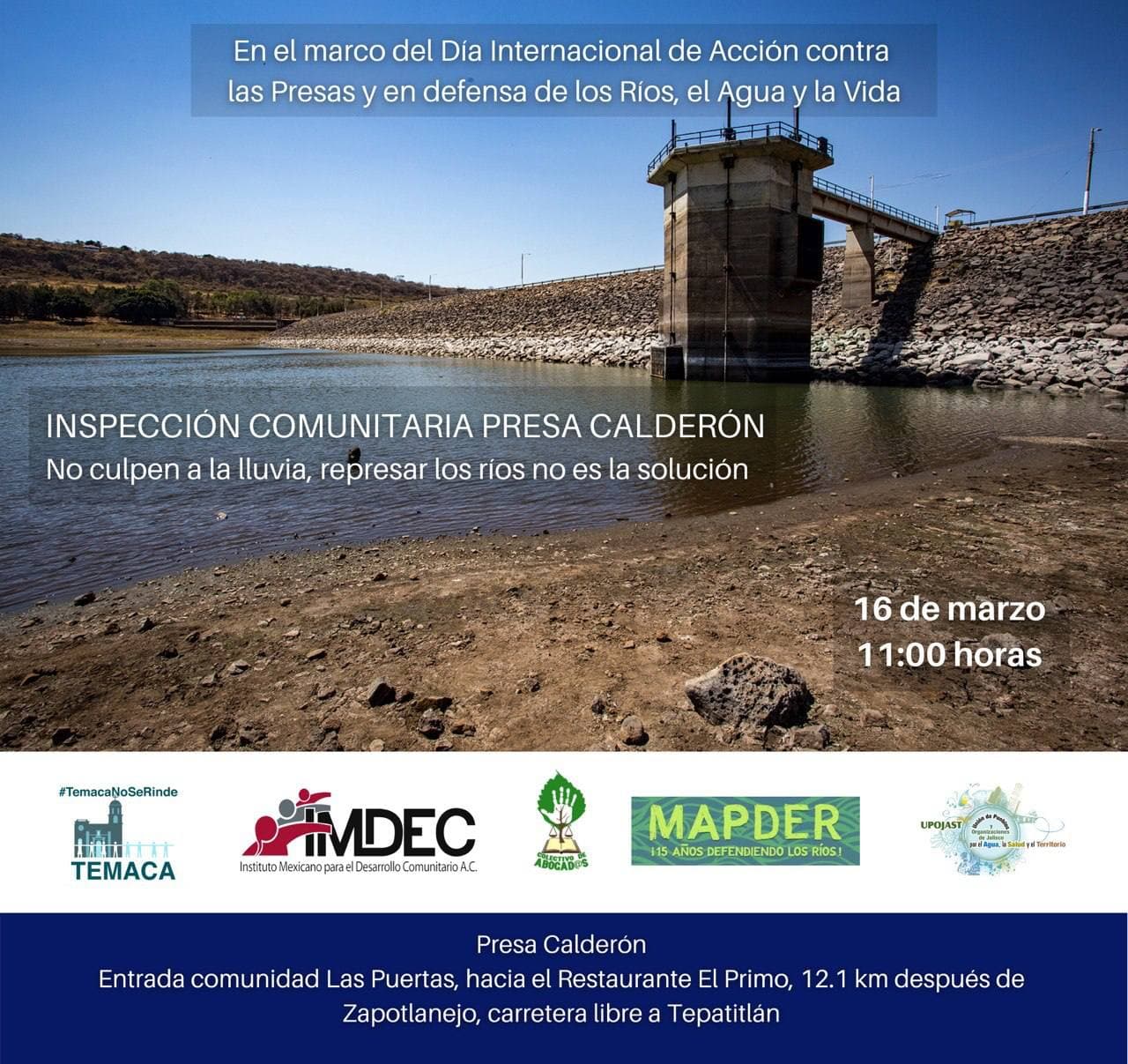
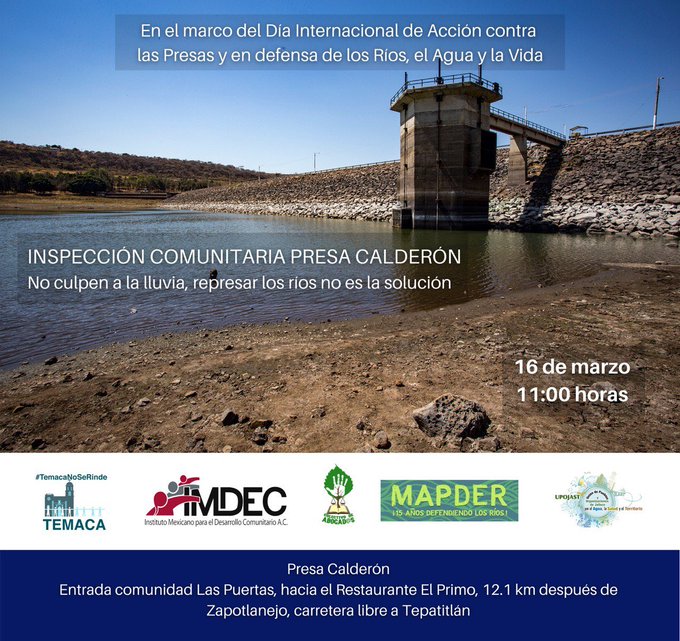
🌊 Mañana #14DeMarzo se celebra el “Día Mundial de Acción en Defensa de los Ríos y en Contra de las Presas, el Agua y la Vida”.
Te invitamos a movilizarnos el martes #16DeMarzo, a las 11 hrs, en la #PresaCalderón en Jalisco #ZapotilloNoVa
No culpen a la lluvia, represar los Ríos no es la solución.
Es urgente #DebartirAlternativas sociales, equitativas y sustentables sobre nuestra #Agua. Les esperamos 💧
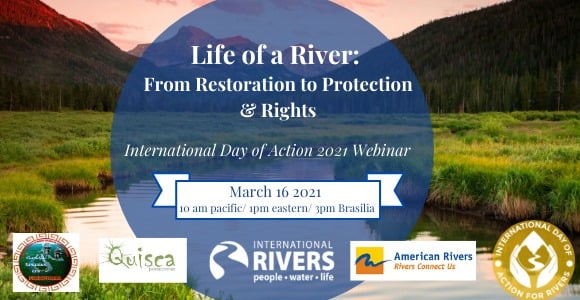
📌No se pierda esta maravillosa oportunidad de escuchar historias inspiradoras sobre ríos de todo el mundo y aprender de los líderes que están marcando la diferencia en algunos de los problemas fluviales más urgentes de nuestro tiempo.@intlrivers
👉https://bit.ly/3qq0z6p
This Day of Action, International Rivers and American Rivers are joining together to host a virtual event.
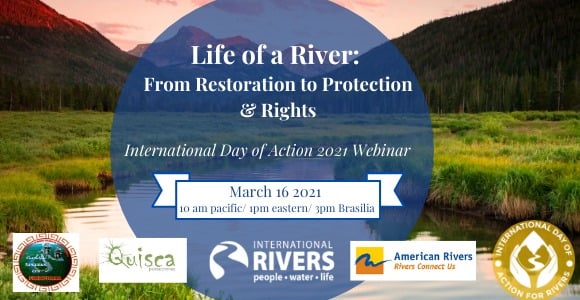
We invite you to join us on March 16, at 10am pacific time, for “Life of a River: From Restoration to Protection and Rights.”
We will be screening a series of short films from regions spanning from the Peruvian Amazon, to the Pacific Northwest of the United States. Our partners including community activists, indigenous leaders, and environmental lawyers will discuss various tactics and efforts to stop dams, uplift Indigenous rights, and protect rivers.
(Please note: contact information will be shared with International Rivers and American Rivers. You can view International Rivers and American Rivers’ respective privacy policies on their websites)
16 mar. 2021 Hora 10:00 a. m. en Hora del pacífico (EE. UU. y Canadá)
IMDEC AC
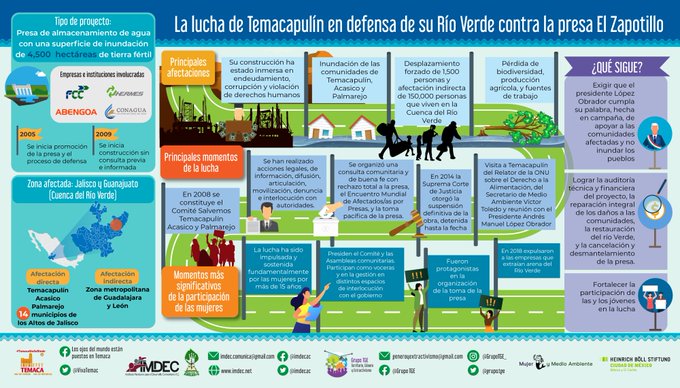
No podemos hablar de las Mujeres Defensoras Del Agua sin Las Mujeres De Temaca conoce en qué etapa está la lucha, a través de esa linda Infografía que realizamos-.
La Presa El Zapotillo en Jalisco se encuentra detenida desde el año 2014, gracias a la valiente lucha de Las Mujeres De Temaca Guardianas Del Río Verde.
Conoce y únete a su lucha #8M2021

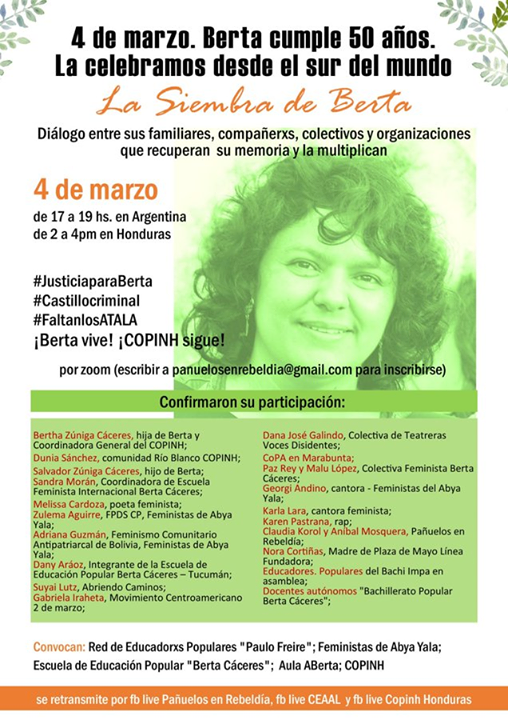
Enjoy the rebroadcast of our virtual concert «#JusticeForBerta” in commemoration of her life
Join us through our social networks.
12:00pm- Honduras
7:00pm- Europe
Por Redacción La Coperacha – Ciudad de México – 29 marzo, 2021
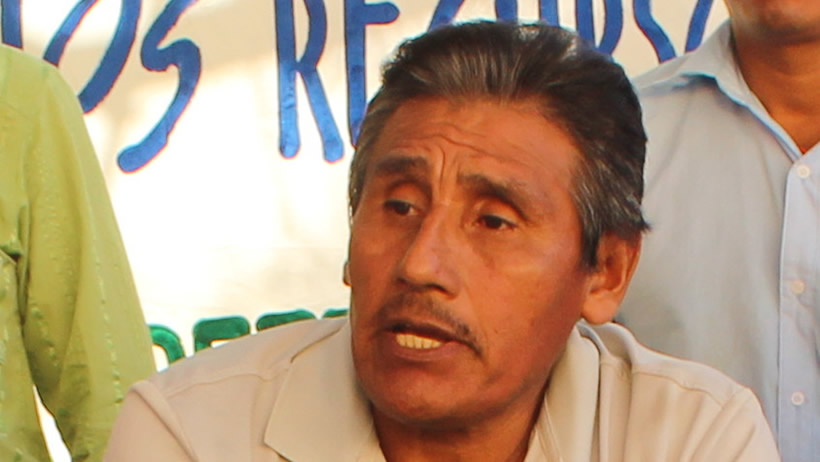
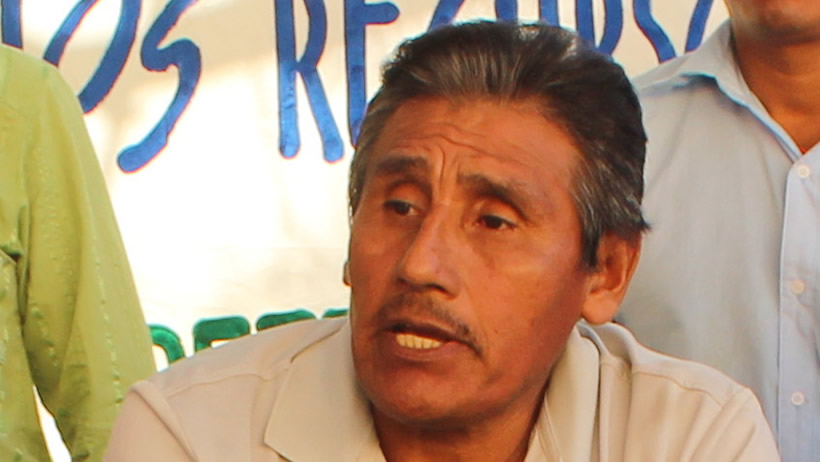
La tarde de ayer, domingo 28 de marzo, fue asesinado a balazos el defensor comunitario Jaime Jiménez Ruiz, ex agente municipal de Paso de la Reyna, reconocido por su defensa del Río Verde. El deceso ocurre a dos meses del asesinato de Fidel Heras Cruz, que a la fecha sigue impune.
Jiménez Ruiz, baleado en el camino de Santiago Jamiltepec a Paso de la Reyna, era integrante del comité de la asociación ganadera local y activo militante del partido Morena.
A 24 horas del asesinato, las autoridades locales seguían en la espera de la Policía Estatal para ofrecer medidas de seguridad en una comunidad de apenas 500 habitantes.
La organización Educa Oaxaca señaló que la comunidad de Paso de la Reyna no cuenta con ninguna medida cautelar de autoridades estatales o federales a pesar de que entre el 14 y 15 de marzo fueron asesinados los ciudadanos Raymundo Robles Riaño, suplente del agente municipal, Noé Robles Cruz, y Gerardo Mendoza Reyes, esto en el Barrio Chico de Paso de la Reyna.
La organización, que ha acompañado el proceso de defensa del territorio contra megaproyectos hidroeléctricos y el extractivismo, identificó que Paso de la Reyna “sufre el autoritarismo caciquil y la impunidad, que son las causas estructurales de la partida violenta de cinco de sus ciudadanos en este año”.
Así mismo resaltó que, entre el cambio del titular de la fiscalía y el paro de la Policía Estatal, no hay condiciones para garantizar los derechos de las personas, “más aún cuando está en pleno desarrollo el proceso electoral”.
“Exigimos a la Defensoría de los Derechos Humanos del Pueblo de Oaxaca que dicte a la brevedad medidas cautelares para la agencia Paso de la Reyna, a fin de salvaguardar la integridad de la ciudadanía”, apuntó Educa en un comunicado.
https://lacoperacha.org.mx/asesinan-defensor-rio-verde-jaime-jimenez-ruiz-oaxaca/
Ríos Internacionales realizará el evento virtual “La vida de un río: de la restauración a la protección y los derechos” el 16 de marzo a las 10 am, hora del Pacífico.
Incluirá proyección de documentales de la Amazonia peruana hasta el noroeste del Pacífico de los Estados Unidos, así como la conversación de activistas comunitarios, líderes indígenas y abogadxs ambientales en torno a tácticas y esfuerzos para detener las represas, elevar los derechos indígenas y proteger los ríos.
¡DIFUNDE!
¡PARTICIPA!
International Rivers
📌Happy #WorldHealthDay!
Our health and the health of rivers and freshwater ecosystems are deeply intertwined. Everyone has the right to healthy food, and clean water and air!
 Human Rights February 24, 2021
By: Deborah Moore, International Rivers Board Member Darryl Knudsen, Executive Director Michael Simon, former Senior Director of Strategy
This article was originally featured on Truthout
There’s some good news amid the grim global pandemic: At long last, the world’s largest dam removal is finally happening.
The landmark agreement, which was finalized in November 2020 between farmers, tribes and dam owners, will finally bring down four aging, inefficient dams along the Klamath River in the Pacific Northwest. This is an important step in restoring historic salmon runs, which have drastically declined in recent years since the dams were constructed. It’s also an incredible win for the Karuk and Yurok tribes, who for untold generations have relied on the salmon runs for both sustenance and spiritual well-being.

The tribes, supported by environmental activists, led a decades-long effort to broker an agreement. They faced vehement opposition from some farmers and owners of lakeside properties, but in 2010, they managed what had seemed impossible: PacifiCorp, the operator of the dams, signed a dam removal agreement, along with 40 other signatories that included the tribes and the state governments of Oregon and California. Unfortunately, progress stalled for years when questions arose around who would pay for the dam removals.
The dam removal project is a sign of the decline of the hydropower industry, whose fortunes have fallen as the troubling cost-benefit ratio of dams has become clear over the years. The rise of more cost-effective and sustainable energy sources (including wind and solar) has hastened this shift.
This is exactly the type of progress envisioned by the World Commission on Dams (WCD), a global multi-stakeholder body that was established by the World Bank and International Union for Conservation of Nature in 1998 to investigate the effectiveness and performance of large dams around the world. The WCD released a damning landmark report in November 2000 on the enormous financial, environmental and human costs and the dismal performance of large dams. The commission spent two years analyzing the outcome of the trillions of dollars invested in dams, reviewing dozens of case studies and testimonies from over a thousand communities and individuals, before producing the report.
But despite this progress, we cannot take hydropower’s decline as inevitable. As governments around the world plan for a post-pandemic recovery, hydropower companies sense an opportunity. The industry is eager to recast itself as climate-friendly (it’s not) and secure precious stimulus funds to revive its dying industry — at the expense of people, the environment and a truly just, green recovery.
The world’s largest hydropower dam removal project on the Klamath River is a significant win for tribal communities. But while the Yurok and Karuk tribes suffered terribly from the decline of the Klamath’s fisheries, they were by no means alone in that experience. The environmental catastrophe that occurred along the Klamath River has been replicated all over the world since the global boom in hydropower construction began early in the 20th century.

The rush to dam rivers has had huge consequences. After decades of rampant construction, only 37 percent of the world’s rivers remain free-flowing, according to one study. River fragmentation has decimated freshwater habitats and fish stocks, threatening food security for millions of the world’s most vulnerable people, and hastening the decline of other myriad freshwater species, including mammals, birds and reptiles.
The communities that experienced the most harm from dams — whether in Asia, Latin America or Africa — often lacked political power and access. But that didn’t stop grassroots movements from organizing and growing to fight for their rights and livelihoods. The people affected by dams began raising their voices, sharing their experiences and forging alliances across borders. By the 1990s, the public outcry against large dams had grown so loud that it finally led to the establishment of the WCD.
What the WCD found was stunning. While large dam projects had brought some economic benefits, they had also forcibly displaced an estimated 40 to 80 million people in the 20th century alone. To put that number into perspective, it is more than the current population of present-day France or the United Kingdom. These people lost their lands and homes to dams, and often with no compensation.
Subsequent research has compounded that finding. A paper published in Water Alternatives revealed that globally, more than 470 million people living downstream from large dams have faced significant impacts to their lives and livelihoods — much of it due to disruptions in water supply, which in turn harm the complex web of life that depends on healthy, free-flowing rivers. The WCD’s findings, released in 2000, identified the importance of restoring rivers, compensating communities for their losses, and finding better energy alternatives to save rivers and ecosystems.
Twenty years after the WCD uncovered a crisis along the world’s rivers and recommended a new development path — one that advanced community-driven development and protects freshwater resources — we find ourselves in the midst of another crisis. The global pandemic has hit us hard, with surging loss of life, unemployment and instability.
But as governments work to rebuild economies and create job opportunities in the coming years, we have a choice: Double down on the failed, outdated technologies that have harmed so many, or change course and use this transformative moment to rebuild our natural systems and uplift communities.
There are many reasons to fight for a green recovery. The climate is changing even faster than expected, and some dams — especially those with reservoirs in hot climates — have been found to emit more greenhouse gases than a fossil fuel power plant. Other estimates have put global reservoirs’ human-made greenhouse gas emissions each year on par with Canada’s total emissions.
Meanwhile, we now understand that healthy rivers and freshwater ecosystems play a critical role in regulating and storing carbon. And at a time when biodiversity loss is soaring, anything we can do to restore habitat is key. But with more than 3,700 major dams proposed or under construction in the world (primarily in the Global South, with over 500 of these in protected areas), according to a 2014 report — and the hydropower industry jockeying for scarce stimulus dollars — we must act urgently.
So what would a strong, resilient and equitable recovery look like in the 21st century? Let’s consider one example in Southeast Asia.
Running through six countries, the Mekong River is the world’s 12th-longest river and is home to one of the world’s most biodiverse regions and the world’s largest inland fishery. Around 80 percent of the nearly 65 million people who live in the Lower Mekong River Basin depend on the river for their livelihoods, according to the Mekong River Commission. In 1994, Thailand built the Pak Mun Dam on a Mekong tributary. Six years later, the WCD studied the dam’s performance and submitted its conclusions and recommendations as part of its final report in 2000. According to the WCD report, the Pak Mun Dam did not deliver the peaking energy service it was designed for, and it physically blocked a critical migration route for a range of fish species that migrated annually to breeding grounds upstream in the Mun River Basin. Cut off from their customary habitat, fish stocks plummeted, and so did the livelihoods of the local people.
Neighboring Laos, instead of learning from this debacle, followed in Thailand’s footsteps, constructing two dams on the river’s mainstem, Xayaburi Dam, commissioned in 2019, and Don Sahong Dam, commissioned in 2020. But then a sign of hope appeared. In early 2020, just as the pandemic began to spread across the world, the Cambodian government reconsidered its plans to build more dams on the Mekong. The science was indisputable: A government-commissioned report showed that further dams would reduce the river’s wild fisheries, threaten critically endangered Irrawaddy dolphins and would block nutrient-rich sediment from the delta’s fertile agricultural lands.
Studies show that Cambodia didn’t need to seek billions of dollars in loans to build more hydropower; instead, it could pursue more cost-effective solar and wind projects that would deliver needed electricity at a fraction of the cost — and without the ecological disasters to fisheries and the verdant Mekong delta. And, in a stunning reversal, Cambodia listened to the science — and to the people — and announced a 10-year moratorium on mainstream dams. Cambodia is now reconsidering its energy mix, recognizing that mainstream hydropower dams are too costly and undermine the economic and cultural values of its flagship river.
Increasingly, governments, civil servants and the public at large are rethinking how we produce energy and are seeking to preserve and restore precious freshwater resources. Dam removals are increasing exponentially across North America and Europe, and movements advancing permanent river protection are growing across Latin America, Asia and Africa.

We must use the COVID-19 crisis to accelerate the trend. Rather than relying on old destructive technologies and industry claims of new-found “sustainable hydropower,” the world requires a new paradigm for an economic recovery that is rooted both in climate and economic justice as well as river stewardship. Since December 2020, hundreds of groups and individuals from more than 80 countries have joined the Rivers4Recovery call for a better way forward for rivers and natural places. This paradigm will protect our rivers as critical lifelines — supporting fisheries, biodiversity, water supply, food production, Indigenous peoples and diverse populations around the world — rather than damming and polluting them.
The promise of the Klamath dam removals is one of restoration — a move that finally recognizes the immense value of free-flowing rivers and the key role they play in nourishing both the world’s biodiversity and hundreds of millions of people.
Healthy rivers — connected to watershed forests, floodplains, wetlands and deltas — are key partners in building resilience in the face of an accelerating climate crisis. But if we allow the hydropower industry to succeed in its cynical grab for stimulus funds, we’ll only perpetuate the 20th century’s legacy of suffering and environmental degradation.
We must put our money where our values are. Twenty years ago, the WCD pointed the way forward to a model of development that takes humans, wildlife and the environment into account, and in 2020, we saw that vision flower along the Klamath River. It’s time to bring that promise of healing and restoration to more of the world’s rivers.
This article was produced by Earth | Food | Life, a project of the Independent Media Institute.
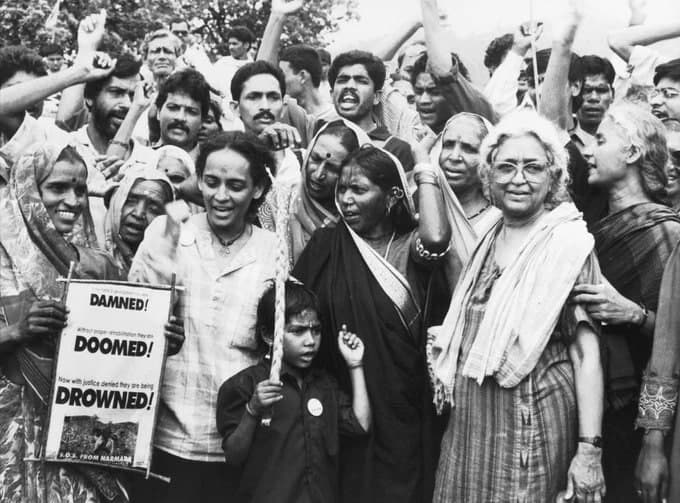
Featured Image: Arundhati Roy and Medha Patkar protest against dams on India’s Narmada River | Photo by International Rivers